Understanding the Shape of the Grid: Spill Mandate Volatility
The historical cost curve generated by the Federal Columbia River Power System (FCRPS) fish operations is anything but linear. Unlike static capital investments, the financial penalty of court-ordered water spills is tied directly to the intersection of Pacific Northwest hydrology and volatile wholesale energy markets.
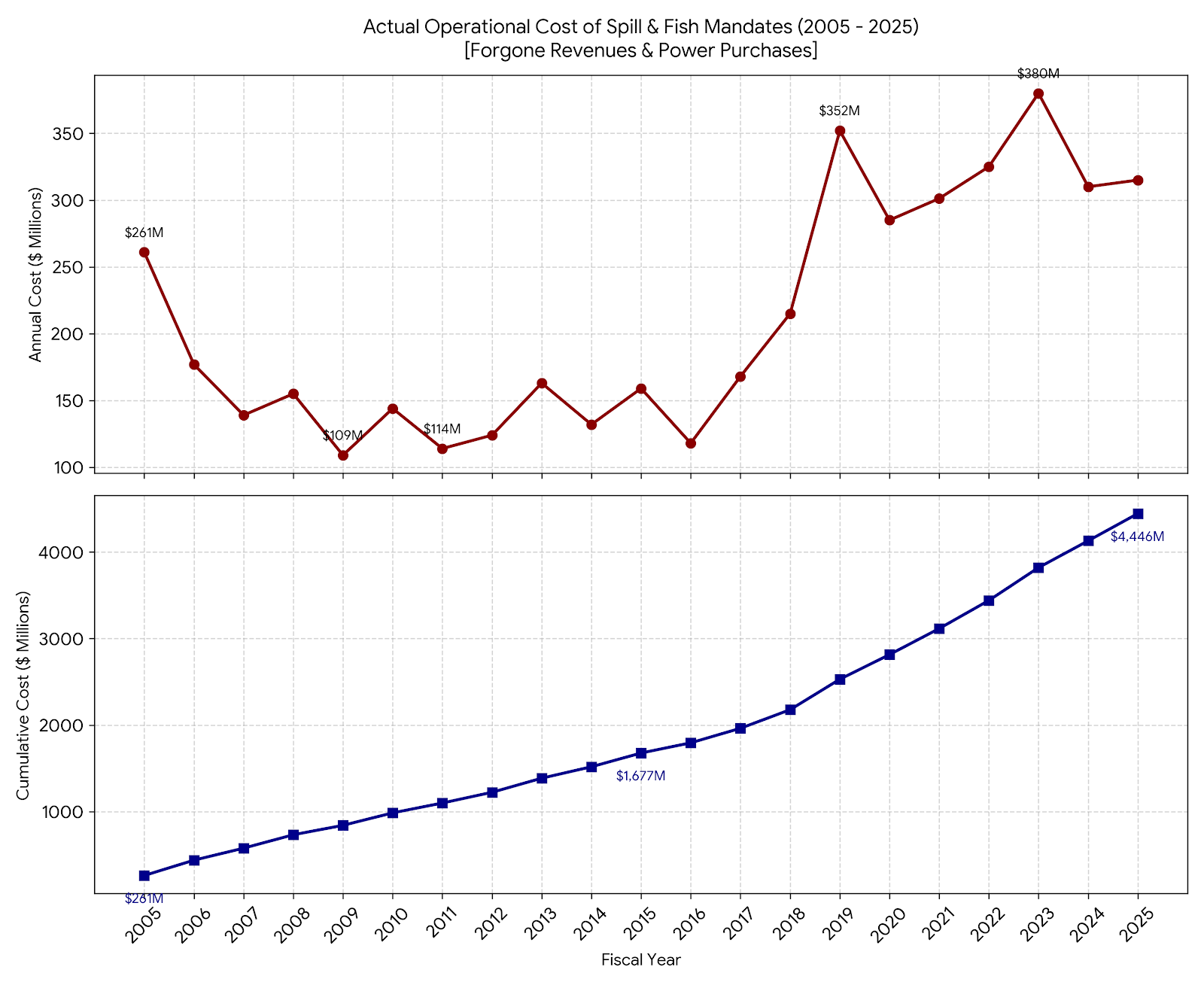
The Core Metric: Cumulative Drain Passes $4.44 Billion
Because these operational costs compound year after year, the true scale of the impact represents the definitive "elephant in the room" for regional power planning. When clean, low-cost water bypasses generation turbines, the system experiences a double penalty: lost sales revenue and mandatory market power purchases.
1. Low-Water Spikes: Droughts & Market Crises
When the region experiences a dry water year with a sparse mountain snowpack, the cost of court-ordered spills shoots upward. With less water in the river system, forcing a massive percentage of it over spillways means the Bonneville Power Administration (BPA) must purchase replacement energy on the open market at peak summer pricing to fulfill its firm contract obligations.
2005 Shockwave ($261M)
A severe regional drought coincided with Judge Redden's initial summer spill order. Because baseline river flows were naturally restricted, the immediate economic penalty of bypassing turbines under tight market conditions was severe.
2023 Market Peak ($380M)
A low-runoff year compounded by unprecedented price volatility across the Western wholesale electricity grid. The cost of every megawatt-hour forced over the spillway reached a historic financial premium.
2. High-Water Dips: Heavy Runoff Insulation
Conversely, when winter mountain snowpacks are exceptional and spring runoff is heavy, the financial penalty of the mandates drops to its lowest levels.
2011–2012 Baselines ($114M / $124M)
Back-to-back near-historic high runoff years. The river system carried so much volume that dams were pushed into "involuntary spill" conditions regardless of court orders, while a surplus of energy across the West drove market replacement costs to near zero.
2016 Stabilization ($118M)
A perfectly timed spring runoff pattern satisfied regional environmental constraints naturally, insulating the system from expensive emergency power market purchases.
3. The Structural Step-Change (2018 – Present)
The sharp upward trajectory in the later years of the chart highlights a fundamental operational shift. With the introduction of Judge Simon’s expanded mandates and the subsequent Flexible Spill Agreement, the baseline volume of mandatory spring spills was pushed to the maximum biological gas caps. Consequently, a modern "normal" water year now costs the region what a "drought" year used to cost fifteen years ago, removing the system's financial cushion.